
Montgomery Release Dates Explained
A projected release date is the correctional agency's working calculation of when confinement should end under the facts then in its file. It begins with the court's sentence and credit for time already served. Staff then apply the correct Maryland diminution-credit rules, which reduce confinement for qualifying conduct, work, tasks, education, or special projects. The date can move as the agency posts credits, joins sentences, receives a new commitment, restores or revokes credit, or learns of a detainer. It is not the same as parole eligibility, maximum expiration, a hearing date, or the day a court reviews bond.
The actual release date records what occurred. For Montgomery County Department of Correction and Rehabilitation custody, a person returning to the community is processed through the Montgomery County Detention Center. Someone can leave the Correctional Facility through transfer to another authority instead. For a state prisoner, release may start parole or mandatory supervision rather than end the sentence. The release record must therefore identify both the date and the destination or legal status that followed.
Scheduled versus actual: a scheduled date is a current calculation. Only the completed custody event and release record establish when and how the person left confinement.
Find a Montgomery Release Date
Start with the sentencing court and the present custodian. Maryland's public Incarcerated Individual Locator is built to locate people now in state correctional custody. The research did not verify that it displays a field called “Projected Release Date” for every record. A missing person or missing date must not be treated as proof of release. DPSCS expressly says that some people may be absent, including people no longer in custody for reasons such as release or escape. Exact sentence-computation records must come from the agency.
- Read the Montgomery County court case. Confirm the case number, sentence, disposition date, and any docketed credit or later sentence modification.
- Identify the custodian. Call DOCR Inmate Records at 240-777-9730 for a local commitment, or use the DPSCS Incarcerated Individual Locator information page for a state commitment.
- Ask for the right computation. For county time, request the release calculation from DOCR. For a state term, ask DPSCS for the commitment summary, sentence calculation, maximum expiration, and mandatory-release information.
- Compare all active cases. Consecutive terms, warrants, detainers, and commitments from another court can control even when one Montgomery County case appears complete.
- Recheck near the expected date. Confirm the custody event with the agency and use VINE as a notification source, not as a certified sentence record.
The complete released-person search and county record request path is on the Montgomery County released inmates page. That route helps when the question shifts from a future date to proof of an actual release.
Montgomery County Release Credits
Maryland uses separate credit rules for local and state confinement. For a local sentence, Correctional Services §11-503 provides five days per calendar month of qualifying presentence confinement. Section 11-504 generally provides ten days per month after sentence, but five days applies when the sentence includes a crime of violence or a listed controlled-dangerous-substance offense. Sections 11-505 and 11-506 cover qualifying work, task, educational, vocational, and special-project credits. Section 11-507 permits disciplinary revocation with due process. The DOCR managing official applies these rules to the actual commitment.
State prison calculations use Title 3, Subtitle 7. Section 3-704 generally awards ten days per month, reduced to five for the stated violent or drug categories. Section 3-705 covers work credit, while §3-706 covers educational and vocational progress. Special-project credit and aggregate monthly limits appear in §§3-707 and 3-708. Eligibility exclusions in §3-702 also matter.
No sound Maryland calculation uses one “serve 85 percent” shortcut. Parole eligibility and conditional release vary with the offense, sentence, offense date, repeat-offender rules, and the correct subsection of §7-301. Outside readers also lack the agency's data on actual awards, forfeitures, restoration, overlapping terms, and court-awarded jail credit. The statute supplies the framework. The custodian's calculation supplies the date.
Local and state credit ledgers should not be combined. A Montgomery County sentence can include presentence time in a local facility, but a later state commitment follows the Division of Correction framework. Court-awarded credit must also be distinguished from credit earned through correctional conduct or a program. When a figure looks wrong, identify the sentence commencement date, every day credited by the judge, each concurrent or consecutive term, and the statutory category the agency used. Then ask the custodian for a corrected calculation or an explanation of the disputed line. Reworking the sentence from public dates alone risks omitting an offense-date rule, forfeiture, or active commitment.
The Maryland General Assembly's state credit definitions and exclusions are shown in the captured official page below.
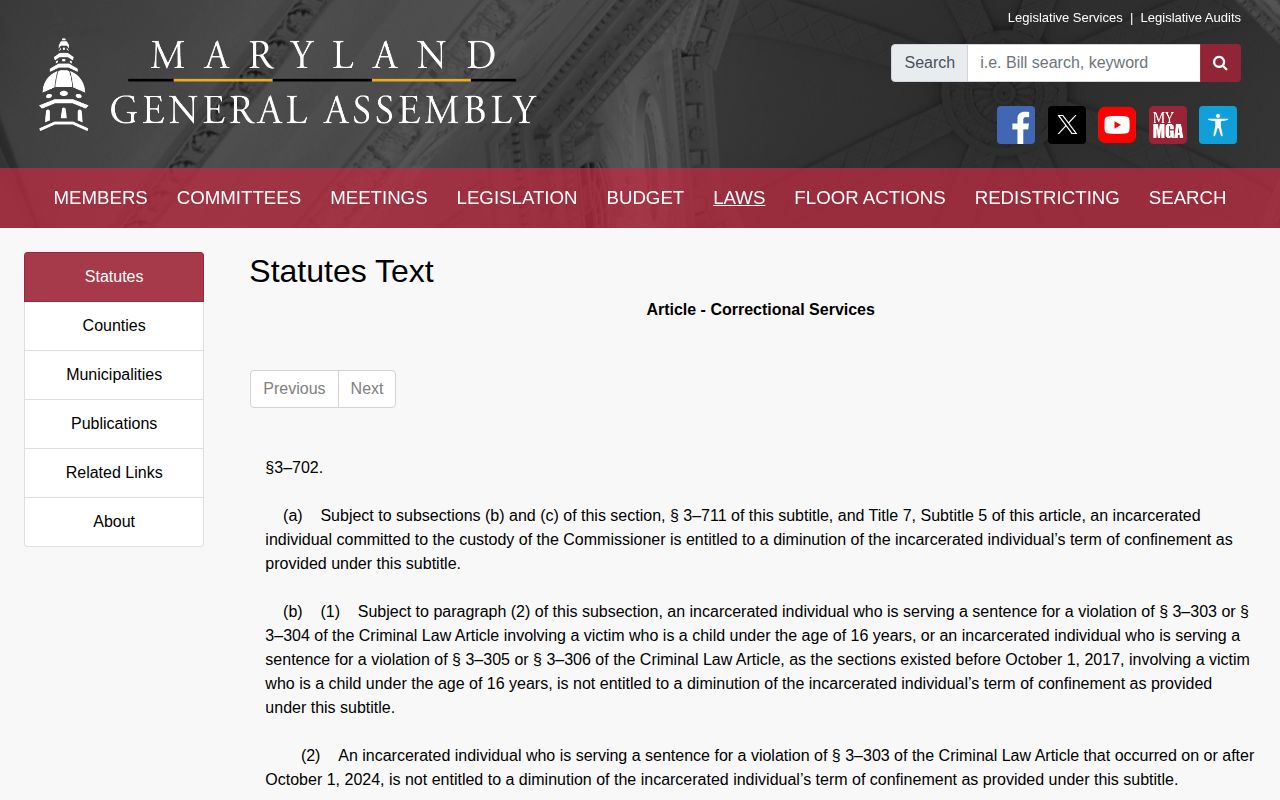
The statute image reinforces why the offense and statutory category must be checked before estimating any Montgomery County release date.
Why Montgomery Release Dates Move
A sentence date changes when the facts in the official calculation change. Some events shorten the expected confinement. Others delay physical release or change the place a person goes next. A date printed on an old paper or shared from memory may therefore be stale even when it was accurate when issued.
| Change | Effect on the release date | Best record |
|---|---|---|
| Jail credit or sentence correction | New court-awarded credit or a corrected start date can move the calculation. | Court order and agency computation |
| Credit earned, lost, or restored | Qualifying awards may reduce confinement; discipline may revoke credit after process. | DOCR or DPSCS credit ledger |
| Consecutive or concurrent case | A second term may follow the first or run with it, depending on the judgment. | Commitment records for every case |
| Parole action | Approval can set a conditional release; refusal or a later rehearing does not do so. | Parole Commission action and DPSCS record |
| Detainer, warrant, or pickup | County confinement may end while custody continues under another agency. | Release destination and receiving-agency record |
| Sentence modification or appeal | A later court order can change the term or legal basis for confinement. | Signed court order and updated computation |
A parole eligibility date is only the first date on which a case may be considered under the governing rule. It is not a promise. An open-hearing calendar is also not a person-by-person release list. Approval, effective date, physical release, and supervision intake are separate events and should be confirmed separately.
Pretrial Montgomery Release Timing
Montgomery County's reentry material says roughly two-thirds of the secure-facility population is pretrial. That group does not have a firm projected sentence-release date because no final sentence controls the custody. Release may turn on a commissioner decision, a judge's bond order, address verification, pretrial conditions, dismissal, or the outcome of trial. A next court date is not the same as a release date.
Even after a court authorizes release, physical departure can take time. Conditions must be satisfied, staff must check for other commitments, and a person at MCCF who is returning to the community is transported to MCDC for processing. Another agency may instead take custody. Ask for the order time, the time the person actually left DOCR, and the destination. Those three facts resolve far more than a single projected date.
Montgomery County's reentry case-management page illustrates the key divide between pretrial uncertainty and planning around a sentenced release.
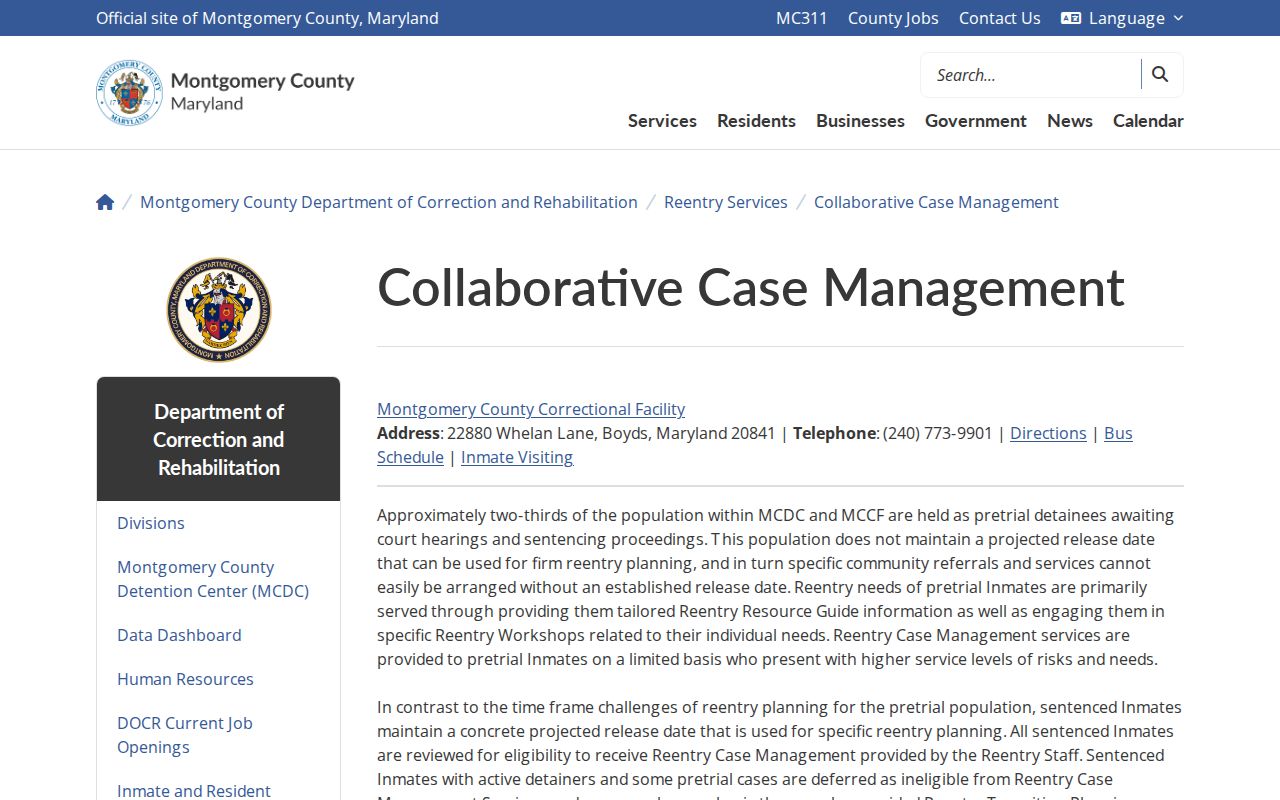
The county source supports treating bond review and sentence computation as different release paths.
Note: A pretrial hearing may change custody, but it does not create the same calculated release date used for a sentenced term.
Montgomery Mandatory Release Status
A Maryland state prisoner may leave confinement through conditional or mandatory release based on diminution credits. Under Correctional Services §7-502, that person remains in legal custody and under parole-like conditions until the full-term expiration date. “Released from confinement” is accurate. “Sentence completed” may not be. Parole likewise replaces incarceration with conditional community supervision while the sentence continues.
- Maximum expiration
- The end of the full sentence as officially calculated, subject to valid later orders.
- Mandatory release
- Release from confinement after applicable credits, followed by legal supervision until expiration.
- Parole eligibility
- The date when the case may first qualify for parole consideration, not a guaranteed exit date.
- Discharge
- The end of the sentence or supervision obligation, distinct from leaving a cell.
For a Montgomery County conviction served in state prison, obtain the DPSCS release certificate or commitment record and then verify any supervision with the Division of Parole and Probation. The county jail record cannot certify what occurred after commitment to the Division of Correction.
Confirm Montgomery County Release
Use the agency record for the date and VINE for an event alert. Maryland VINE receives connected booking and case-management updates on a daily basis, so it is useful but not real time. Search by the name, accepted identification number, or court case number. Check the reporting agency carefully. A Montgomery County DOCR event is not a Maryland Division of Correction event, even though both may appear within the same statewide service.
Telephone registration uses a PIN to confirm receipt, while email sends one notice for a custody-status change. An alert does not establish the destination, clear every detainer, or prove that a sentence ended. The Montgomery County VINE inmate check explains registration and its limits. Near the expected date, call DOCR Inmate Records for county custody or the relevant DPSCS office for state custody.
When formal proof matters, request the release record. Ask for the actual release date and time, release type or authority, destination or receiving agency, and supervision status. If the release has not occurred, request the current computation and ask when it was last updated. This gives a dated, agency-sourced answer rather than an estimate built from incomplete facts.
For a county record, direct the request to DOCR and identify the booking or commitment episode. For state confinement, DPSCS says its PIA form covers department records rather than local detention or court files. Ask for the commitment summary, release certificate, diminution-credit calculation, mandatory-release date, and maximum expiration that apply to the named term. Maryland's PIA generally calls for a decision within 30 days. If production is expected to exceed ten working days, the agency provides an early time and fee estimate. Electronic delivery and a clear cost ceiling can keep the request focused.
Note: A VINE alert is a useful prompt to verify the event, but the originating correctional agency remains the source for the final record.