
Montgomery County Supervision Types
Maryland separates the agency that decides parole from the agency that provides field supervision. The Maryland Parole Commission considers parole and revocation matters. The DPSCS Division of Parole and Probation supervises parolees, probationers, and people released on mandatory supervision. The court imposes probation and records its term in the criminal case.
Pretrial supervision is separate. It applies before final disposition when a court permits community release under stated terms. Montgomery County Pretrial Services handles that local route. A person can also leave incarceration because the sentence expired, with no parole or probation to follow. Read the exact release and sentencing language before assigning a label.
| Status | Who orders or grants it | How to verify it |
|---|---|---|
| Parole | Maryland Parole Commission | Commission action, DPSCS release papers, and DPP instructions |
| Probation | District or Circuit Court | Sentence, docket, and DPP reporting paper |
| Mandatory supervision | Statutory release after qualifying diminution credits | DPSCS release certificate and DPP record |
| Pretrial supervision | Court or commissioner before disposition | Release order and Montgomery County Pretrial Services |
| Discharge | Controlling agency or court when the legal term ends | Final discharge or termination record |
- Parole
- Conditional release from incarceration while the sentence continues under Commission terms.
- Probation
- A court-ordered period of community supervision that can follow custody or replace incarceration.
- Mandatory release
- Release from state confinement based on qualifying credits, with legal supervision through maximum expiration.
- Absconder
- An agency or court status tied to an alleged failure to remain under supervision, not a label to infer from rumor.
- Discharge
- The formal end of the supervision or sentence obligation, which is different from leaving a facility.
Verify Montgomery County Post-Release Supervision
Maryland does not offer a public name-based DPP supervision search. Verification therefore starts with the document that created the status. A court docket can show that probation was ordered. A parole action and DPSCS release paper can show that parole began. A mandatory-release certificate identifies a different route. None of those public records necessarily disclose an assigned agent or daily compliance.
- Obtain the release paper, sentencing order, or Montgomery County court case number. Note whether the language says parole, probation, mandatory release, or pretrial supervision.
- Read the Maryland Judiciary docket for the sentence, probation term, violation entries, or later modification. The clerk’s official file controls.
- For parole, check the Maryland Parole Commission action and the DPSCS release record. A hearing date alone is not an approval.
- Use the release instructions to identify Rockville Intake or the correct Gaithersburg or Silver Spring field office. Ask how the supervised person can confirm the assigned agent.
- When a warrant or violation is alleged, consult the filed court or Commission record. Do not treat a VINE event or an unverified report as proof.
- For final completion, request the discharge, termination, or maximum-expiration record from the authority that supervised the case.
Montgomery County Supervision Offices
The county inmate guide directs people released to parole or probation to Rockville Intake on the next business day unless their court or release papers specify another reporting date. The current DPP office list also identifies field offices in Gaithersburg and Silver Spring. An unrelated caller may receive limited information because supervision records can contain protected details. The supervised person should use the release paper or court case when asking which office handles intake.
Rockville Intake
191 Jefferson Street
Rockville, MD 20850
Phone: 301-563-8715
Fax: 301-563-8720
Gaithersburg Field Office/DDMP is at 7871 Beechcraft Avenue, Suite 200, Gaithersburg, MD 20879, with main number 240-386-2600. Silver Spring Field Office/DDMP is at 8552 Second Avenue, first floor, Silver Spring, MD 20910, with main number 301-563-8620. Call the office list before travel because the research did not verify fixed public counter hours.
The official DPP office directory is the source for Montgomery County supervision locations.
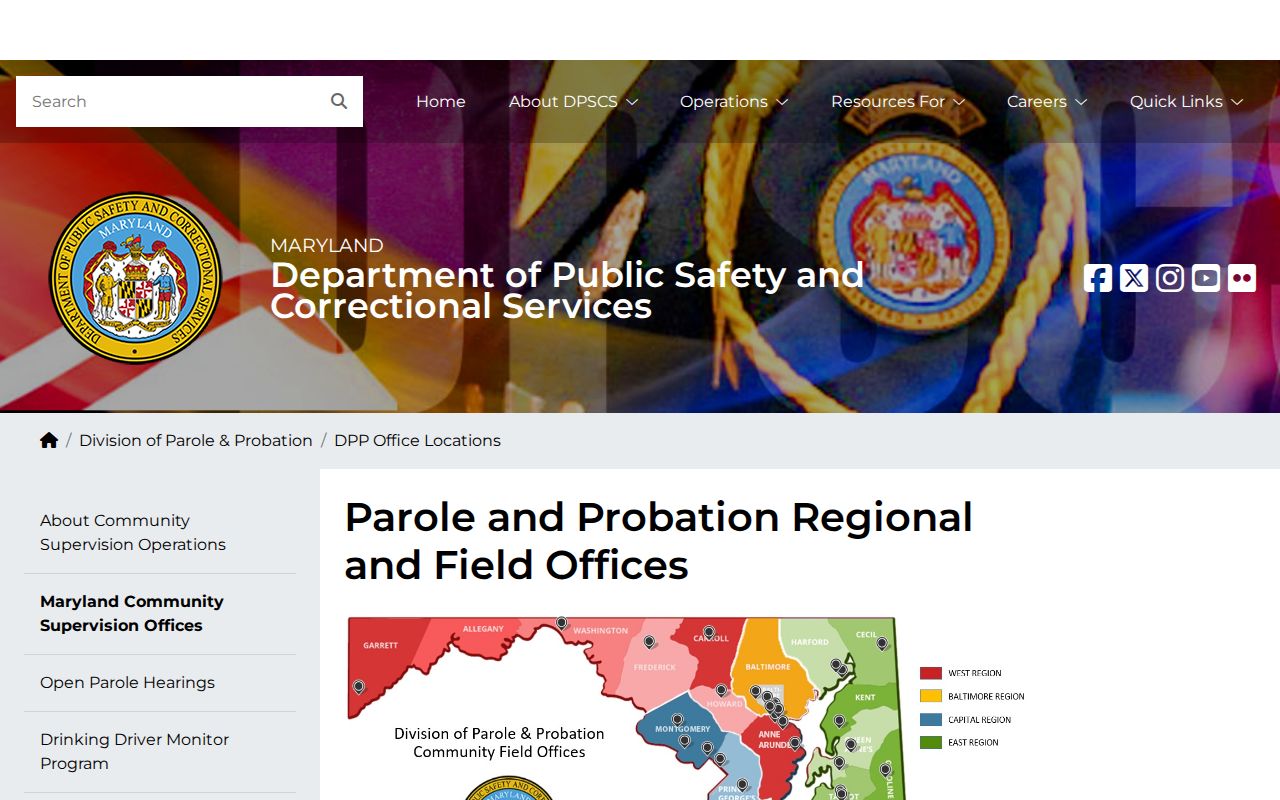
The directory identifies the correct local contact without implying that it offers a public person search.
Montgomery County Parole Decisions
The Maryland Parole Commission may refuse parole, set a future rehearing, or approve conditional release. These outcomes are not interchangeable. A refusal ends that consideration without another hearing under the Commission’s stated process. A rehearing date means review will occur later. Approval authorizes conditional release, but the person remains under the sentence and DPP supervision until maximum expiration unless another controlling action applies.
Most cases use a hearing officer recommendation to a commissioner. Life-sentence and homicide matters use a two-commissioner panel. The Commission posts public business meeting material and a separate annual open-hearing calendar, but no official public person-by-person decision search was found. Do not read a calendar entry as a grant of parole. Match any public action with the final Commission decision, the DPSCS custody event, and the reporting papers.
Parole eligibility is also not a release promise. Under Correctional Services §7-301, the ordinary threshold for a sentence of at least six months is one-fourth of the aggregate sentence, while crimes of violence, life sentences, certain repeat offenses, and nonparole terms follow different rules. The offense date and controlling subsection matter.
Montgomery County Supervision Violations
Conditions come from the controlling court order, Commission action, and release papers. They may require reporting and compliance with case-specific directions. Public summaries should stay at that level because the terms differ by person. A docket can show an alleged probation violation or warrant. A Commission record can show parole rescission or revocation action. Neither should be replaced by a commercial list or an unsupported claim.
An “absconder” status concerns an alleged failure to remain under supervision. It should be used only when an official agency or filed record uses that term. A missed call, a stale address, or a VINE status is not enough. If a warrant is suspected, check the originating court or Commission record and ask the proper office how the supervised person can address it.
Revocation can return a person to confinement, but a violation filing is not the same as a final revocation. Note the allegation, hearing, decision, and later custody event as separate steps. That sequence preserves the difference between pending process and a completed decision.
When the record says mandatory release, Correctional Services §7-502 is the key distinction. The person is released from confinement on mandatory supervision and remains in legal custody until full-term expiration. A later violation can affect that supervised status. Describe the event with those precise terms instead of calling the sentence complete. For parole, obtain the Commission’s final action. For probation, use the Montgomery County court’s violation and warrant entries, then confirm the disposition rather than stopping at the first filing.
Montgomery County Supervision Discharge
Release from a building does not end every sentence. Maryland Correctional Services §7-502 provides that a person on mandatory supervision remains in legal custody under parole-like conditions until full-term expiration. Parole also continues under DPP supervision until the controlling end point, subject to Commission action. Probation ends under the court’s order or a later termination.
Maryland’s earned compliance credit statute, Correctional Services §6-117, can reduce an active-supervision or home-detention period after the Division’s recommendation. The statute distinguishes that abatement from the legal expiration and other continuing obligations. It is a supervision calculation, not county jail good time and not automatic proof of full discharge.
Ask for the final discharge or termination record when the end date matters. For probation, use the Montgomery County court file and DPP. For parole or mandatory release, use DPSCS, DPP, and the Commission action where relevant. The broader Montgomery County release record search explains how the original custody event and court disposition fit together.
Montgomery County Release Reentry Support
DOCR’s reentry unit coordinates programs at MCCF. Pre-Release and Reentry Services operates residential and nonresidential community corrections from 11651 Nebel Street in Rockville. County materials describe reentry mediation, parole and probation orientation, identification help, and links with outside agencies. These programs help a person navigate release duties, but they do not change the legal source of supervision.
A PRRS participant can have an approved community pass or home confinement while still accountable to the county program. Physical presence in the community is not proof of discharge. Confirm completion through PRRS or DOCR records and the sentencing case. For a person leaving state prison, confirm whether DPP supervision follows and use the reporting location on the release paper.
Property After Montgomery County Release
Supervision reporting can begin while practical release tasks remain unfinished. MCCF property may not reach MCDC until the next business day. The released person has 30 days to collect it personally or through an agent with a signed, notarized authorization. A DCA-14A authorization completed while inside remains on file for 10 days.
Montgomery County also issues a Community Reentry Identification Card for 60 days after release. DOCR materials say the card can serve during that period as a no-cost Ride On pass and library card. It may help with travel to reporting appointments and reentry services, but it is not permanent state identification and does not prove that parole or probation ended.